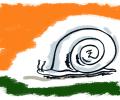
We could be on the brink if our export industries actually start losing jobs, says Shreekant Sambrani.

How will the return of a majority government at the Centre, the new India-US friendship and the Mangalyaan triumph change India?

'If we don't want to be the poorest large economy even in 2030, we need to be doing very much more than is being attempted.'

'China's development is on a different scale from India's. They are very far ahead.' 'I don't think it will be possible in the next 30 years for us to catch them,' says Aakar Patel.
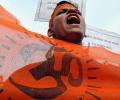
India's majoritarian regime is now making a dangerously fast-paced move towards theocracy, like its western counterpart did a few decades ago, warns Mohammad Sajjad.

The first set of routes that it will launch internationally will be the routes that can be flown by its existing aircraft, the A320s, which will be routes within three, three-and-a-half hours of India

Hemant Kanoria tells Niraj Bhatt why understanding the dynamics of the borrower's business is critical for the lender.

The more one thinks about it, the more difficult it is to see how India will be able to reap the benefits of a demographic dividend, says Aakar Patel.

PM Modi's China visit may strengthen ties between both the countries.

Rajeev Srinivasan on how Indians are satisfied with illusions, not reality.
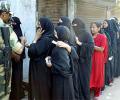
'It was Dr B R Ambedkar's foresight which saved us from some marauding state political leaders who could have indirectly disfranchised large sections of our population as we see some attempts even now,' says V Balachandran.

Sadly, for hundreds of millions in India, that inequality from their birth and the utterly inadequate schooling and health care they receive thereafter mean that the lottery is stacked against them.
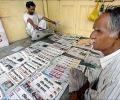
The six are English dailies the Hindustan Times, The Hindu and The Telegraph; their sister publications The Hindustan and The Hindu Tamil; and Ananda Bazar Patrika.

'At the very end of his speech, he dealt with the 'small problems' of Indian workers. But these measures did not seem to satisfy those who had expected the prime minister to find solutions for their problems. That the prime minister generally focused on broad policy issues and not on matters of detail left them bewildered,' says Ambassador T P Sreenivasan.

South and South-West Asia could witness an economic growth of 5.3 per cent in 2015, which will be a four-year high.
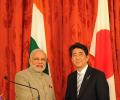
'Secretiveness and the element of surprise in announcing decisions marks the Modi style of diplomacy. From being a voluble politician, he became a reticent statesman... But the diplomatic dance is performed on thin ice and his adroitness is still to be proved,' says Ambassador T P Sreenivasan.
 © 2026 Rediff.com - Advertise with us - Disclaimer - Privacy Policy - Sitemap - Feedback - About us - Terms of use - Grievances